
Become an advanced practice provider for individuals and families. In this two year program, you'll engage early and continuously in clinical practice and research, gaining the skills and experience needed to become an advanced practice nurse. Graduates are well prepared for careers as leaders in clinical practice and education.
Have more questions? Our team is here to help. Contact us to learn more about the program, admissions, or student experience.
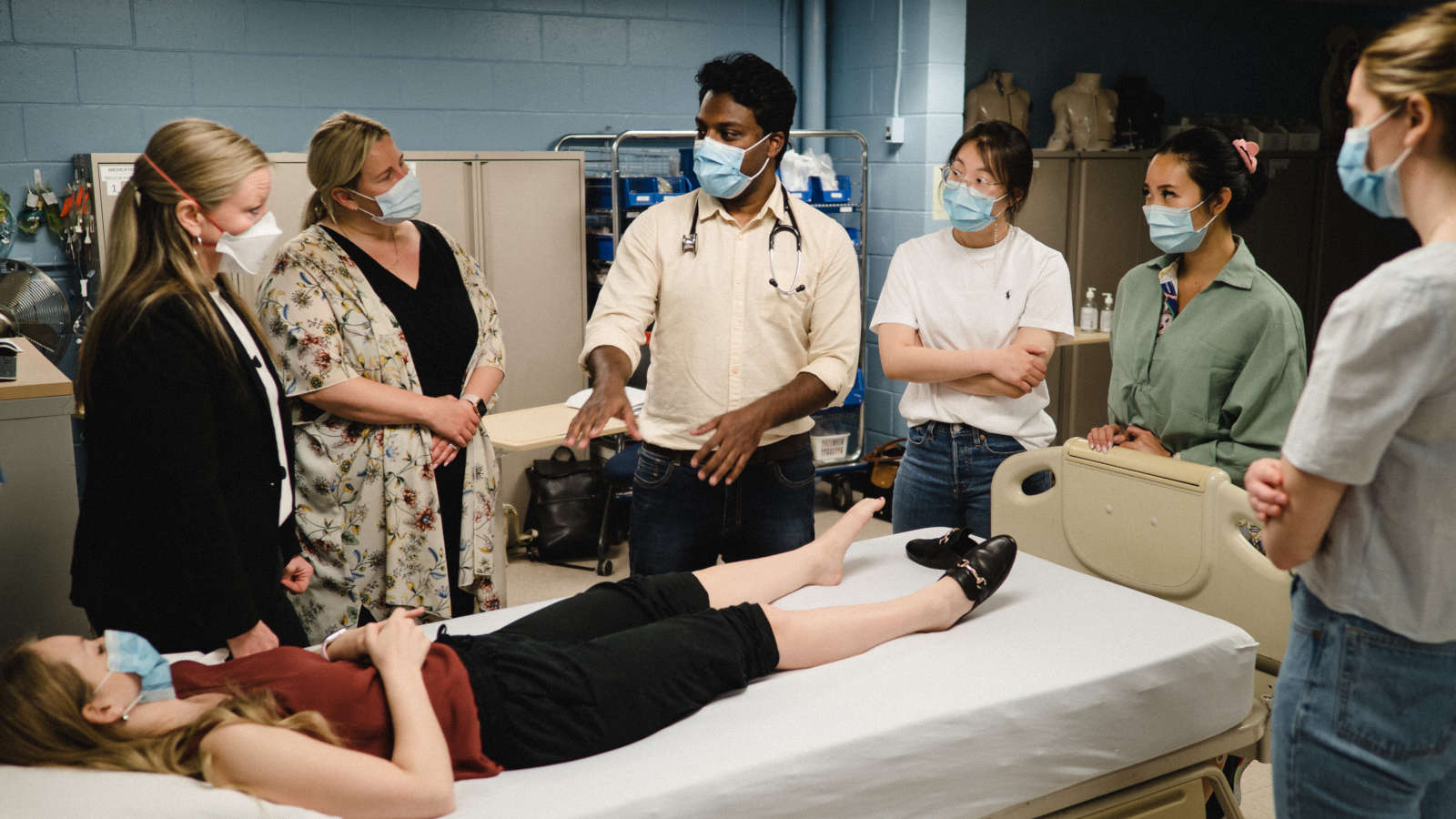
Your learning experience
Our Master of Nursing - Nurse Practitioner program consists of coursework, clinical placements, integrated practicum, and systematic review. In collaboration with a consortium of nine Ontario universities, you will be taught primarily through small in-person graduate seminars, clinical placements, and self-directed learning online. You will engage in a critical examination of theory and research, applying knowledge and skills related to pathophysiology, health assessment, diagnostics, therapeutics and the nurse practitioner role. Once you complete this two-year program, you'll be eligible to write the Canadian Nurse Practitioner Licensure Examination (CNPLE).
Additional information about the Ontario Nurse Practitioner Education Consortium (ONPEC) can be found at http://np-education.ca.
Already have a master's in nursing? Consider our NP Graduate Diploma program.
Please note: International students cannot apply to this program unless they have active registration as a registered nurse with the College of Nurses of Ontario in Canada.
Additional Resources
- School of Graduate Studies and Postdoctoral Affairs (SGSPA)
- SGSPA Academic Calendar - Nursing Section
- Society of Graduate and Professional Students
- Queen’s Nursing and Health Research
Fall 2025 Information Webinar Recording
Fall:
NURS 804 (3.0 cr) - Applied Research Methods in Nurse Practitioner Practice
NURS 812 (3.0 cr) - Professional Identity and Advocacy for Nurse Practitioner Practice
NURS 850A - Pathophysiology for Nurse Practitioners (continues into Winter term)
NURS 856 (4.5 cr) - Advanced Health Assessment and Diagnosis I (includes clinical placement)
Winter:
NURS 806 (3.0 cr) - Nurse Practitioners Leading Change and Influencing Policy
NURS 850B (3.0 cr) - Pathophysiology for Nurse Practitioners
NURS 857 (4.5 cr) - Advanced Health Assessment and Diagnosis II (includes clinical placement)
Spring/Summer:
NURS 898 (4.5 cr) - Project in Evidence Based Practice
Fall:
NURS 858 (4.5 cr) - Therapeutics I (includes clinical placement)
NURS 853A - NP Roles and Responsibilities (continues into Winter term)
Winter:
NURS 859 (4.5 cr) - Therapeutics II (includes clinical placement)
NURS 853B (3.0 cr) - NP Roles and Responsibilities
Spring/Summer:
NURS 854 (12 cr) - Integrative Practicum (includes clinical placement)
Students of the Ontario Nurse Practitioner Education Consortium must complete clinical placements in the geographical area of their home university, as arranged by the Clinical Placement Coordinator. See the map at https://onpec.ca/documents/googlemap/9regions.php for Queen's University placement boundaries. Students are not permitted to arrange their own placements.
You are responsible for your own transportation to and from clinical placements. During the program you will be placed at multiple agencies throughout the region. Many rural and remote sites are not accessible by public transit.
Some of our clinical placement partners include:
- Kingston Health Sciences Centre
- Tsi Kanonhkhwatsheríyo Indigenous Interprofessional Primary Care Team
- Quinte Health
- Corrections Canada
- Providence Manor
- And variety of rural family health teams and clinics
Students must complete a total of 728 clinical placement hours during the program, divided across multiple courses. The final Integrated Practicum requires 416 hours of clinical and 36 hours of seminar over the 13 week term.
Admissions
Applications open: mid-September
Applications due: February 1
Applications to all graduate programs are made through the School of Graduate Studies and Postdoctoral Affairs starting in September for admission the following year.
Please note, only complete applications will be reviewed by the Graduate Program Committee in the School of Nursing.
Queen's Health Sciences (QHS) and Graduate Nursing Programs are committed to advancing equitable and inclusive approaches to admissions and education. Faculty, staff, and learners involved in application review complete training designed to detect and minimize bias in admissions. Visit Queen's Health Sciences EDIIA for more information.
Academic Requirements
- Graduation with a minimum of a second class standing (overall average equivalent to B) from a baccalaureate program in nursing that has been approved by a provincial/territorial authority and has received CASN accreditation.
- Two academic letters of reference (e.g. course professors in undergraduate program).
- One clinical reference (three referees total). See Additional Requirements for more details.
- A statistics course and a research course at the undergraduate level. If you are unsure whether your courses meet program requirements, send the course details to grad.nursing@queensu.ca.
- Active registration as a Registered Nurse with the College of Nurses of Ontario. International applicants cannot enroll in this program unless they have active registration as a Registered Nurse with the College of Nurses of Ontario and are a resident in Ontario.
Indigenous Applicants
Queen’s welcomes and encourages inquiries and applications from Indigenous candidates. If you are an Indigenous applicant and wish for your application to be considered under the “Indigenous Student Admission Regulation,” you must self-identify as Indigenous upon application for admission. For the purposes of this regulation, Indigenous is defined as First Nation, Métis, and Inuit (FNMI). Visit our Indigenous applicants pathways page for further details.
Additional Requirements
In addition to the online application you will submit to Queen's Graduate Studies and Postdoctoral Affairs, the following must be submitted to grad.nursing@queensu.ca:
- One Clinical Reference (e.g. your manager or supervisor), submitted directly by the referee.
- Proof of at least two years of relevant full-time practice as a registered nurse within the past five years (minimum of 3640 hours). All applicants must have their employer(s) complete a "Verification of Employment Hours" form.
- Statement of Interest - Use standard font and margins. Include your surname in the filename, e.g. "Doe, Jane_NP SOI".
- What is your motivation for becoming a Nurse Practitioner? What are your career goals? Max. 300 words.
- What personal attributes and professional experiences do you bring to the NP role? What are your current strengths and weaknesses with respect to the *entry-level competencies for NPs? Max. 300 words. *Visit CNO Become A Nurse.
- As you transition from RN to NP, how do you see your role evolving as both a clinician and advocate? How will you incorporate principles of indigeneity, equity, diversity, inclusion, accessibility, and anti-racism (I-EDIAA) into your future NP practice? Max. 300 words.
- Proof of current RN Registration with the College of Nurses of Ontario (e.g. your Find a Nurse profile) or equivalent. Applicants licensed in other Canadian provinces/territories must register with CNO prior to starting the program.
- Curriculum Vitae (Resumé).
Frequently Asked Questions
Have more questions? Our team is here to help. Contact us to learn more about the program, admissions, or student experience.
Students can expect to spend a minimum of 35-40 hours per week, inclusive of seminars, clinical placements, coursework (e.g. readings, assignments, exams), and placement travel. Due to the intensive time demands of the program, full-time employment is not recommended.
No, the program is offered full-time over two years at Queen’s.
For a lighter course load over a longer time frame, consider applying to the Master of Nursing Science (course-based or thesis based option), and then returning for the Nurse Practitioner Graduate Diploma.
No. The MN-NP program requires attendance at on-campus courses, most of which are organized as seminars requiring active discussion among and presentations by you and your classmates. There is an expectation that you attend and actively participate in courses, scholarly presentations and research events in the School of Nursing, within the Faculty of Health Sciences and within the University's community in general.
The MN-NP program is eligible for the Ontario Learn & Stay Grant.
There is no guaranteed internal funding for the MN-NP program. There are a small number of awards based on academic excellence. You will also have the opportunity to apply for roles as a teaching assistant and/or research assistant. Students who present at conferences can apply for funding support to cover registration and travel expenses. We encourage you to apply for external funding from professional associations, such as the RNAO Nursing Education Initiative Grant Program.
To enroll in the MN-NP program, you must be licensed as a Registered Nurse with the College of Nurses of Ontario.
The Nurse Practitioner Program at Queen’s University is approved by the College of Nurses of Ontario (www.cno.org). Current graduates from this program are eligible to apply for Extended Class registration as a Nurse Practitioner in Ontario.